



Marlin Communications: Then & Now - A retrospective with Founder & Idealist Karl Tischler
— Interview by Jenni Whittaker, General Manager at Marlin Communications.
What originally motivated you to start Marlin Communications and what personal belief or experience made you commit to working with charities and not-for-profits specifically?
Wow… what a question. To be honest, my original motivations weren’t so noble and altruistic. I needed a job and to earn some money!
However several years ago, I did the Australian Progress Fellowship which was life changing. I learned about the idea of public narrative and had to develop my own. My public narrative involved three near death experiences, and being able to articulate that was fundamental.
Ever since, I realised that I did not survive what I went through just to be average or comfortable. I want to bring an energy and conviction to our sector and the clients we work with. I want people to feel that the causes and charities we serve are worth fighting for and I want us all to move beyond comfort and toward feeling part of a solution.
That’s why I am here. In my day-to-day work, I want to use my time, skills and the agency I started to do some good in the world.
Over the years, Marlin has supported small, medium and large organisations in Australia and abroad – what keeps you energised and motivated?
It is the causes and charities we serve.
In particular, it is always the people we work with—the people who think and feel in similar ways and who have chosen to spend their careers working in charities.
Our work is hard. That is not an exaggeration. Changing hearts and minds and encouraging people to give their money, time and voice is relentlessly difficult. But it is entirely worth it.
When we experience success, when we see people act differently, it is a genuine buzz.
That, and my garden. To be frank, without that solace and space I think I would have lost my mind long ago…
When you reflect on the hardest moments of building Marlin Communications, what has kept you anchored to the mission rather than shifting to more commercial work?
There was never really an option of doing more commercial work. Not because I wasn’t able, but because the kind of skills and experience Marlin has developed are very niche. I now view this as a strength. It creates a moat that differentiates the business and has real value.
There is also a kind of quiet hardship that comes with this, which is bittersweet. After a while, I felt in my bones that I was doing profoundly meaningful work with Marlin, but you also start to feel there are no other paths. You become wedded to the business.
This is going to sound cheesy, but despite those hard moments, I also know that the work we’re doing is quite possibly the most important work of all. It is work that matters.
We’re energised by seeing our clients succeed and highlighting those wins. Is there a standout insight from the last year that has reshaped the way you think about the sector or the work we do?
I think there are two parts to this. The first is Marlin-specific. The second is sector-specific.
The key realisation for myself in the last year was that our agency can be a business that does good, and also be a good business. The agency folk out there will realise what I am talking about… running an agency is bloody hard.
On the sector side, I feel as though much of the last year was about the importance of gifts in Wills. The second insight is something I have always believed; that charities need to invest where the greatest return is, and that’s with upper mid-value and major donors.
Looking ahead, what change do you hope Marlin will help create in the sector over the next 5–10 years, and what personally excites you most about that future?
Let me start with a cliché: change is constant. There is nothing we can do about that except adjust and adapt. I often catch myself thinking that if we can just reach a level of stability things will feel easier, but that is never going to happen.
However, just because change is constant and often overwhelming does not mean it should steal our attention or our time.
When I feel overwhelmed by the volume of information and pace of change, I try to ask myself what never changes. It is calming, but it is also revealing.
What never changes is an audience’s capacity to care, their need to be compassionate and then express that.
Years ago, I read George Smith’s book ‘Asking Properly’. He wrote that the three greatest words in charity are ‘pity, love and compassion’. That will never change.
Every generation has its bias, and I have long believed that the next five to ten years will be the most consequential of any and all time. Why? Because in ten years the realities of climate change will be felt in ways our social and political systems simply cannot absorb. This is irreversible. Once it happens, we will not return to what was.
As humans, we will do what we have always done. Our greatest strengths are cooperation, adaptation and resilience.
The role I see Marlin playing aligns with our brand promise:
‘Lives are saved, rebuilt and improved through the actions of social change makers. No one should feel hopeless or forced to accept the status quo. No one should feel too insignificant to shape their life or change their world.’
I do not see a bleak future; but I see it as profoundly shaped by many bigger than self factors and that will create enormous social uncertainty and loss of control.
The demand for the work our clients deliver will increase dramatically and this will happen in an environment flooded with communications. So, who do people listen to? Who do they trust? Will they prioritise some causes over others? How will we continue to express our humanity?
In this environment, the role and value of persuasive creative will skyrocket.
The change I hope Marlin creates, and the one that excites me most, is our ability to meet this moment with truly persuasive communications. Work that recognises human behaviour does not fundamentally change. Kindness, compassion and love will always matter most.

Jenni Whittaker, General Manager
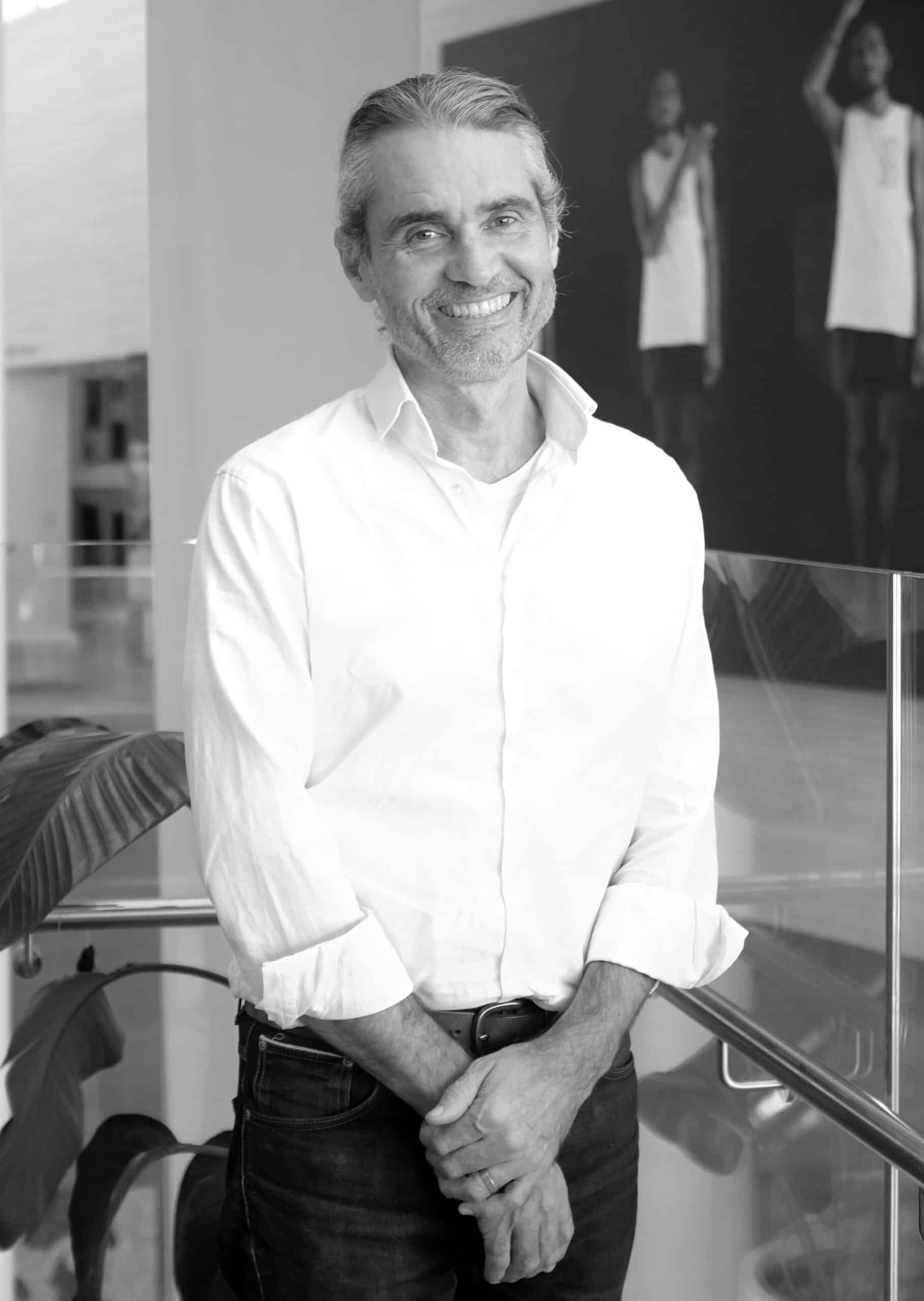
Karl Tischler FFIA, Founder & Idealist